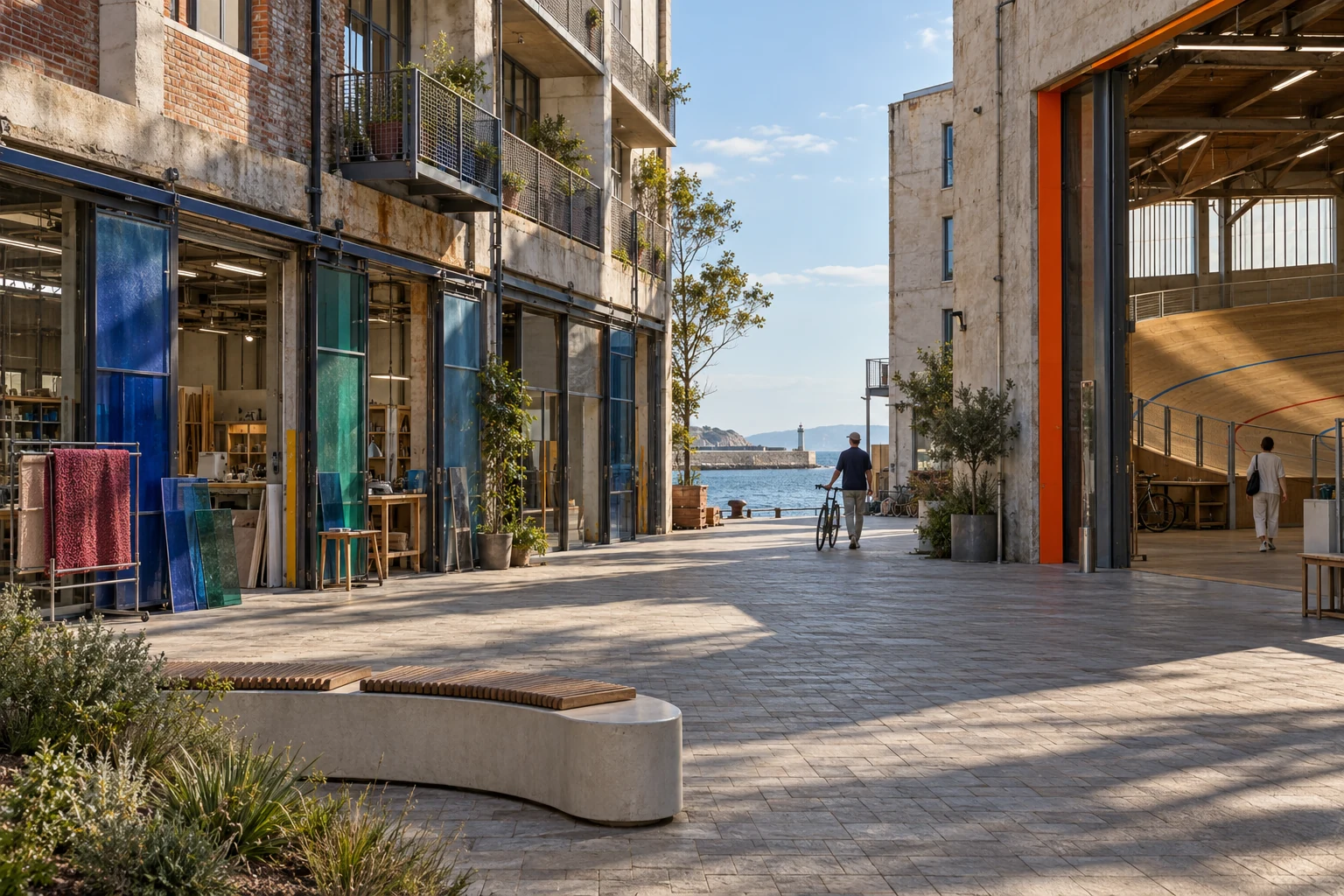
A coastal city learning to make room for more than one way of living.
In Rill, a goods hall can hold a cycling club, a workshop and an evening meal. Objects pass between homes, fitting rooms and repair counters. The most interesting design question is often a small one: what would let this person take part, on their own terms?
Space is shared. Bodies are individual. Time is never as equal as the booking sheet makes it look.
01
A place to return to
The Lower Ring
A former goods hall holds a timber velodrome, changing benches and a club room. A separate level running court shares the entrance; the banked oval belongs to bicycles. Practice, spectators and shared meals use different hours.
A moment here +
At 06:40, Tomas slides the lap board back to blank. Ada has booked a timed session. The next rider has booked a quiet one. Both belong on the timber.
The unresolved question. A one-hour slot is not an equal offer when preparation takes different amounts of time. The club is still arguing about handover time.
02
The ordinary, together
The Long Rooms
Communal rooms within ordinary residential buildings: reading, sewing, meals, an untidy table and somewhere to be quiet without being alone.
A moment here +
Mina turns her raspberry INTERVAL object toward “Taking a moment.” Ivo leaves the kettle on. Company is available; conversation is not an obligation.
The unresolved question. Shared space makes company easy and privacy difficult. The small customs work only when people respect them.
03
Between things
The Upper Walk
A raised route between the waterfront, housing and workshops. Stops, shade and places to sit are part of the route, not interruptions to it.
A moment here +
The ferry ramp is wet again. Mina marks that moment with FOOTNOTE instead of expecting a sensor to guess why one stretch of the walk felt different.
The unresolved question. The shortest route on a map is not always the easiest route on a particular day. There is no universally correct itinerary.
04
Time for an individual
The Fitting Rooms
Independent specialist practices beside everyday shops. Personal material samples, appointments with room to talk, and useful disagreements about what feels right.
A moment here +
Nell puts three MARGIN samples on the table. “Softer” turns out to mean a different edge, not simply a different material. They start the conversation again.
The unresolved question. A useful conversation cannot always be compressed into a convenient timetable. Skilled work and return visits have real costs in this fiction.
05
Make the connection clear
The Tool Commons
Workshops and a strength club share a building. Tools, personal equipment and training hardware have distinct owners and uses.
A moment here +
A GRIP cuff waits in its DOCK at the training bench. Across the corridor, Ivo adjusts a red pull loop on a tool bag. Similar gestures; different equipment and responsibilities.
The unresolved question. A visible connection invites understanding, but it does not make every attachment interchangeable. Clear boundaries are part of good design.
06
An object’s next chapter
The Return Arcade
Independent repair desks, parts records and second-owner exchanges share an arcade. Someone is responsible for receiving a returned part, not just designing its box.
A moment here +
A worn ROAM sole arrives in a lilac RETURN cassette. Its label records a repair that failed as well as one that worked. History survives the new part.
The unresolved question. Keeping everything can be wasteful too. Reuse, disposal and replacement remain material decisions, never a miraculous closed loop.
02 / The organisationsIndependent, by design.
Two convictions. Common ground.
The person is the point.
SPLICE
The equipment is a means. The life around it is everything.
An independent human-performance and adaptive-design studio, established in 2026. Seven practices work on different moments in a person’s day.
How it works, and where it struggles +
Core systems are imagined around individual specialist fitting; ordinary companion objects can stand on their own. Service parts and care are part of the catalogue, not an afterthought.
The tension. Personal fit takes time. A small studio cannot make every option affordable simply by calling it inclusive.
Repeated movement in one well-made place can be a destination.
An independent experimental track-bike studio. Its first V/01 study dates to 2026; the Lower Ring later gives that thinking a local home.
How it works, and where it struggles +
A small cycling catalogue holds the whole ritual: transport, preparation, the bicycle, the session and the contact surface. Club stewardship matters as much as private ownership.
The tension. The light, spare machine a designer wants is not always the easy-to-share machine a club needs.
One studio begins with a person. The other begins with a bicycle. Their meeting point is a softer, replaceable contact surface—not a merger, a universal fitting or a claim that every attachment belongs on a bike.
03 / The product worldsDifferent questions. Different forms.
A family resemblance. A point of difference.
Each practice has a belief, a material language and a daily ritual. Colour is the consequence, not the whole idea.
Website concept / S/02
SPLICE / REST
The right to an interval.
Stopping is an ordinary part of living, not a failed performance.
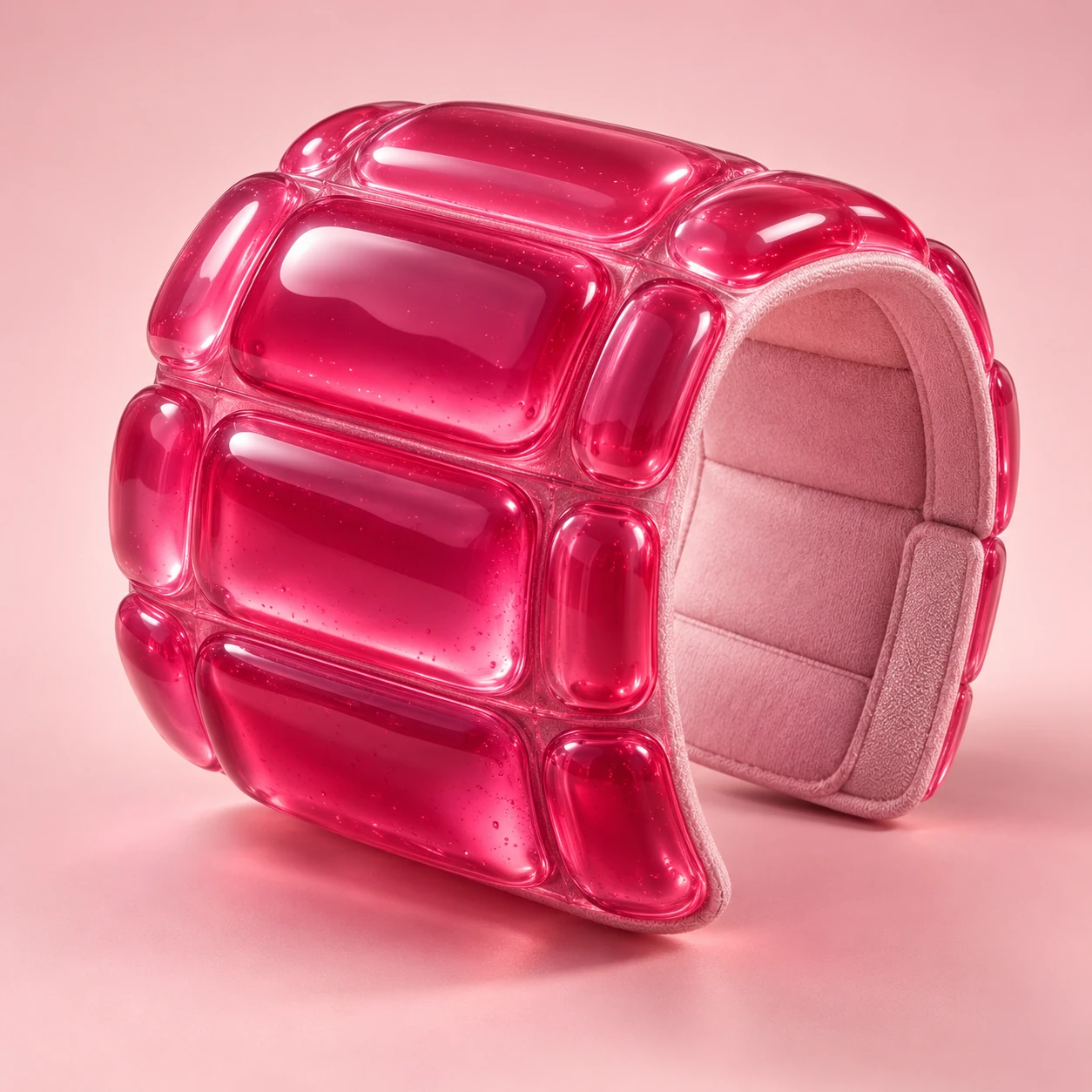
In the Long Rooms, people wanted a way to be present without being available. The wrap’s soft vocabulary becomes a small language of pauses.
RaspberryAn object at home in domestic life.
BlushSoft surrounding space.
PlumCalm, readable instructions.
Shape
Joined cells, generous gaps, open ends, soft objects with a clear side to turn toward someone.
Material
Translucent welded cells outside; familiar textile on the contact side. No heating system is implied.
Voice
Warm, dry and slightly odd. “Taking a moment.” No recovery score or optimisation language.
Movement
A surface settles around a curve; changes happen gently and can stay still.
Ritual, wear and the unresolved question +
The ritual
Turn INTERVAL yourself. Unfold LANDING. Nobody else decides when your break is over.
Packaging
Reusable blush textile pockets with simple personal marks rather than clinical-looking trays.
Wear
Visible clouding and textile wear should be honest. The catalogue must not promise hygienic reuse without a material protocol.
The tension
A shared pause signal depends on courtesy. Buying an object cannot make a household respect it.
What it will not do
Countdowns on rest, medical heating claims, infantilising copy or jokes at someone’s expense.
The workaround, the place, the person. Open any record to see why it belongs here and what it connects to.
11 existing website concepts. 15 new written concepts. New concepts have full dossiers; their product assets and pages are future work.
26 objects / all practices
S/01● Website concept
STRIDE
STRIDE
Core running-system study
A carbon running system around which a repeatable practice can form.
The Lower Ring
S/01-A○ World concept
STRIDE
BOW
Equipment cradle
An open cradle that gives a detached running blade somewhere definite to rest.
The Lower Ring
S/01-B○ World concept
STRIDE
TALLY
Personal manual lap counter
One generous button and one number for a session that does not need another screen.
The Lower Ring
S/02● Website concept
REST
REST
Soft wrap
Connected soft cells make a place for the quieter part of movement.
The Long Rooms
S/02-A● Website concept
REST
INTERVAL
Personal pause signal
A soft object that says whether you feel available for company.
The Long Rooms
S/02-B● Website concept
REST
LANDING
Foldable rest surface
A small connected-cell surface for the in-between places.
The Lower Ring
S/03● Website concept
SENSE
SENSE
Contact-sensing insole study
A familiar foot outline gives an otherwise invisible contact pattern a readable place.
The Upper Walk
S/03-A○ World concept
SENSE
TRACE
Local contact reader
A tabletop reader that lets someone revisit one contact sequence at their own pace.
The Long Rooms
S/03-B○ World concept
SENSE
FOOTNOTE
Manual context marker
A pocket control for attaching your own circumstances to an observation.
The Upper Walk
S/04● Website concept
FORM
FORM
Prosthetic liner study
A continuous soft interface gives the part closest to a person its own design attention.
The Fitting Rooms
S/04-A○ World concept
FORM
TURN
Liner care frame
An open frame gives a liner a defined place between cleaning and its next use.
The Long Rooms
S/04-B○ World concept
FORM
MARGIN
Specialist material sample library
A book of edges for a conversation that is difficult to have using adjectives alone.
The Fitting Rooms
S/05● Website concept
GRIP
GRIP
Adaptive training attachment study
A padded cuff and a fixed open hook make the proposed connection easy to read.
The Tool Commons
S/05-A○ World concept
GRIP
DOCK
Cuff staging fixture
A stable place to position an open attachment before considering the next step.
The Tool Commons
S/05-B○ World concept
GRIP
REACH
Companion training handle study
A proposed equipment-side contact that belongs in the same conversation as GRIP.
The Tool Commons
S/06● Website concept
ROAM
ROAM
Modular everyday prosthetic foot study
A lasting core and distinct outer parts make continued ownership visible in the design.
The Upper Walk
S/06-A○ World concept
ROAM
SECOND SOLE
Proposed service replacement
A named replacement contact surface gives the repair story an actual catalogue part.
The Return Arcade
S/06-B○ World concept
ROAM
RETURN
Parts-return cassette
A worn part travels with an identity instead of disappearing into anonymous packaging.
The Return Arcade
S/07● Website concept
THREAD
THREAD
Tendon-driven hand study
Visible pulling lines connect a gesture to a set of articulated parts.
The Long Rooms
S/07-A○ World concept
THREAD
PAGE
Reading companion
Two page fingers share one broad release control.
The Long Rooms
S/07-B○ World concept
THREAD
HEM
Textile pull-loop set
Small replaceable loops give tiny clothing and bag pulls a larger gesture.
The Long Rooms
V/01● Website concept
VELODROME
V/01
Track bicycle study
One fixed gear and a continuous line anchor VELODROME's track culture.
The Lower Ring
V/02○ World concept
VELODROME
BETWEEN
Trackside preparation stand
An open rail gives the bicycle and the rider's loose equipment a shared place between laps.
The Lower Ring
V/03○ World concept
VELODROME
INDEX
Manual session lap board
A large shared number gives rider and trackside partner a simple point of agreement.
The Lower Ring
V/04○ World concept
VELODROME
ROUNDTRIP
Bicycle transport case
A case whose inside explains the journey from home to track and back.
The Long Rooms
OL/01● Website concept
SPLICE × VELODROME
OPEN LINE
Shared contact-material study
A replaceable contact surface asks how the hand might meet a carbon bar more thoughtfully.
The Lower Ring
No objects in this combination.
Try another place or clear the filters to return to the full catalogue.
05 / A life beyond equipmentResidents, not brand ambassadors.
Nobody is a product brief.
Objects reveal small parts of these lives. They do not explain the whole person.
MV
Ferry dispatcher
Mina Vale
Mina knows the city by changes of shift. She shares meals with Ivo but does not share his conviction that every broken thing can be saved.
Also: Choir rehearsals, a small balcony garden, reliably overfilled shopping bags.
The Upper Walk / The Long Rooms
RO
Frame builder
Ren Okafor
Ren values a spare, exact machine. Club use keeps confronting that preference with the marks, labels and adjustment records real sharing needs.
Also: Film projection and a fermentation shelf that occupies too much of the kitchen.
The Lower Ring / The Tool Commons
IS
Ceramic repairer
Ivo Sen
Ivo can make a repair look beautiful. His harder lesson is learning when a person wants a dependable replacement rather than another interesting repair.
Also: Slow chess games and notebooks of weather that nobody asked him to keep.
The Return Arcade / The Long Rooms
AS
Librarian and club rider
Ada Sol
Ada and Ren are friendly rivals on the track. Away from it, PAGE leaves her hands free to arrange a reading table without sacrificing the page she was on.
Also: Ghost stories, late screenings and fierce opinions about lending annotations.
The Lower Ring / The Long Rooms
NM
Independent fitting practitioner
Nell Mercer
Nell resists tidy explanations that arrive before a person has finished describing their experience. She is not an employee of either studio.
Also: Drawing the backs of buildings and swimming before the city is awake.
The Fitting Rooms / The Upper Walk
TA
Club caretaker
Tomas Ahn
Tomas sees the gap between a catalogue promise and the job of putting everything away. He keeps blank spaces on the session board deliberately.
Also: Birdwatching and elaborate puppets made for very small audiences.
The Lower Ring / The Return Arcade
06 / How this world came to beFounding collection → imagined future
A history of small consequences.
2026
The founding collection
SPLICE is established. V/01 and the first OPEN LINE contact study belong to this founding design archive. The existing websites retain their 2026 date.
2031
The lower district changes hands
Freight operations relocate. Large buildings become available, but their maintenance is too expensive for many small occupants to carry alone.
2033
A voluntary agreement
Participating tenants write Common Hours into shared leases: access periods, handovers and named stewardship. It is a local compact, not a law that makes everything free.
2035
The Lower Ring opens
A goods hall becomes a timber-track club. VELODROME’s bicycle practice finds a home among people who use the same space for different reasons.
2037
The Return Arcade forms
Independent service desks coordinate records and parts returns. Repair now has an address, an owner and a paper trail—including failed attempts.
2039
The loan-bike conversation
A club review shows that adjusting bicycle dimensions does not settle every point of contact. SPLICE and VELODROME revisit the original OPEN LINE archive together.
2041
This edition
The city has a fuller catalogue and better habits, not a finished utopia. Who gets time, what can be shared and what is worth keeping remain open questions.
07 / Rules for what comes nextA world that can keep making sense.
Build from a reason. Then make it strange.
01
Start with the situation.
Name a person’s task, their current workaround and the change the object offers. “It looks interesting” is not a product brief.
02
Keep the companies different.
SPLICE begins with individual agency. VELODROME begins with a particular practice and place. A partnership should reveal a useful disagreement.
03
Give the supporting objects a place.
Storage, preparation, care, replacement and return are part of the same product story. Avoid unrelated accessories invented to fill a shop.
04
Let materials explain aesthetics.
A cell grid, a printed pathway or a pulling line should account for the graphics and motion. The family must remain recognisable without its colour.
05
Make the strange usable.
An odd object needs an ordinary ritual. INTERVAL makes a social preference visible; it does not monitor someone’s mood.
06
Preserve a life beyond equipment.
People have jobs, tastes, disagreements and relationships. Nobody is a diagnosis, a brand ambassador or a shopping list.
07
Never infer compatibility.
Shared thinking is not a shared fitting. A cuff, a handlebar insert and a liner can influence one another without becoming interchangeable.
08
Leave the disagreement alive.
Time, money, space and skilled work remain limited. The catalogue can improve a situation without declaring the world solved.